
C O N T E S T S
2026 Sacred Poetry Contest
Congratulations to the Finalists and Winners of CLA’s 2026 Sacred Poetry Contest!
This year’s finalists are: Vivian I. Bikulege, Jerome Gagnon, Kristi A.S. Gomez, Maura Harrison, Robert Kirkendall, Joan Lange, Aline Lewis, Rhonda Melanson, Paul Pastor, Jess Pettit-Tarquinio, Arthur Powers, and M.D. Skeen.
From these finalists were chosen the winning entries listed below.
We encourage you to join us for the Virtual Celebration of Winners and Finalists with judge Daniel Tobin, on Monday, May 4, 2026, 7:00 p.m. CST. Please register at this link to attend via Zoom.
Please read the winning entries below.
First Place: Kristi A.S. Gomez
Second Place: Joan Lange
Third Place: M.D. Skeen
Honorable Mention: Jerome Gagnon, Aline Lewis, and Rhonda Melanson.

Meet Our Final Judge
Daniel Tobin is the author of ten books of poems, including Blood Labors, named one of the Best Poetry Books of the Year for 2018 by the New York Times and The Washington Independent Review of Books, The Stone in the Air: A Suite of Poems from the German of Paul Celan, and The Mansions, winner of the National Indie Excellence Award in Poetry.
His poetry has won many awards, among them the Massachusetts Book Award, the Julia Ward Howe Award, the Stephen Meringoff Award from the Association of Literary Scholars, Critics, and Writers, and fellowships from the NEA and the John Simon Guggenheim Foundation.
His critical and editorial works include Passage to the Center: Imagination and the Sacred in the Poetry of Seamus Heaney, The Book of Irish American Poetry from the 18th Century to the Present, Poet’s Work, Poet’s Play: Essays on the Practice and the Art (with Pimone Triplett), To the Many: The Collected Early Works of Lola Ridge, Awake in America, On Serious Earth: Poetry and Transcendence and most recently The Odeon: Essays on Poetry. A chapbook, From the Distances of Sleep: Gloss Arias I, appeared in 2025 from Staircase Books. Dusk, Empire: New and Selected Poems, will appear in 2026.
Follow this link to Dan Tobin’s website.
Honorable Mention Awards
The Honorable Mention designation is given to poems of exceptional merit who did not place in this year’s list of the top three award-winning poems. This year’s Honorable Mention designations are awarded to poets Jerome Gagnon, Aline Lewis, and Rhonda Melanson.

Honorable Mention
Jerome Gagnon
A Question of Light
afterMidnight Mass by Clarence Gagnon
Here come the faithful through the fallen snow
in their brown woolen capes and heavy coats.
Something like joy, I think, must lead them
through the white-clad town
to honor mystery, as if for the first time.
But what is this unexpected light, I wonder,
that meets them by the door,
bathing horse and buggy in its stream
and the scarlet sleigh, as well,
pointing as it does toward Bethlehem?
There must be a thousand candles burning
to cast such a glow,
or is it moonlight like an unseen eye
gazing down over all,
or else the hearts of pilgrims blazing?
Sometimes I think it comes from the snow,
rendered in white on white, returning everything
to stillness —
not an answer, quite, but a welcoming —
have deepened my watch for that.
© Catholic Literary Arts

Honorable Mention
Aline Lewis
Descent
After Caravaggio’s The Scourging at the Pillar
Our Lord bends in demi plie.
He is our God in flesh
taking the fourth position
in this mournful ballet.
Naked, just as he was
at his baptism, joining us,
and upon him rested
the gentleness of a dove.
Standing again with sinful men,
his neck, stretched like a swan’s,
his skin thin, over clavicle,
and his pain is human.
But the soldiers, they are brutal.
As boys, did they picture
torturing innocent victims,
dreaming of brave battles?
Who called them to join in this dance?
He who lurks in the dark?
Pilate? Or is it the one
much more ancient, perhaps?
One to untie the Lord’s sandal,
not from humility but for undoing
the epiphany of that day,
invoking the black to fall,
when what’s heard are sounds of hate,
not love from the heavens,
though what happened then
will indeed recapitulate.
The Lord will descend, deeper still,
All the way to the harrowing of hell,
And, here, the Lord turns his face
toward one of his persecutors
with a tormented gaze.
If only that soldier could see his grace.
© Catholic Literary Arts
Honorable Mention
Rhonda Melanson
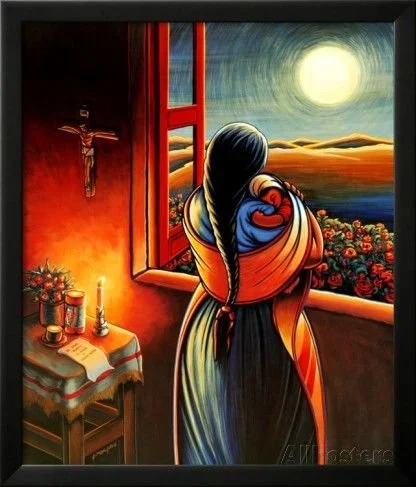
Little Fires Everywhere
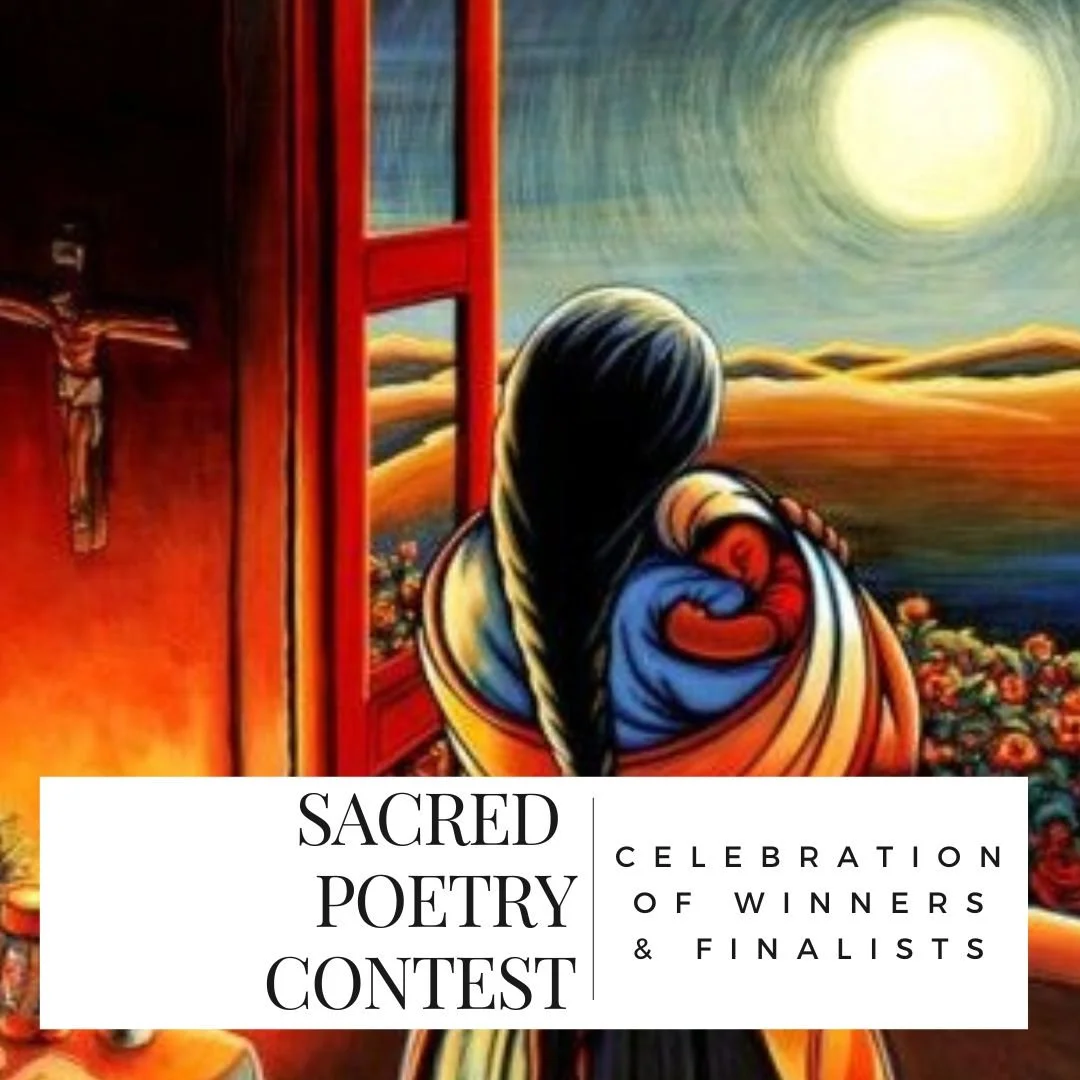
after the painting Love At All Hours by Simon Silva
As you,
newborn mammal to my mama bear
burrow your face into my shoulder,
I realize
you've no need to witness the morning star
that pale balloon in the window frame of dawn.
Because
from an earlier existence, you carry
the flicker. I feel the heat from your breath
the flames
seeking escape. Warmth is not for the weak.
In fact, love sets the room on fire-- demands
fiery disregard
for all things indifferent, unnecessary, cruel.
The world knows these things and more.
What small witness
shall there be, but you and me in the tiny
window of morning? When shall there be
nothing
but little fires everywhere? What colours
will there be, bold in their space taking?
© Catholic Literary Arts

Third Place
M.D. Skeen
Surrender - A Ghazal in Ten Shers
After Stigmatization of St. Francis by Giotto di Bondone
I lift my arms to you Lord in complete surrender
And as unseen nails pierce my hands and feet, surrender.
Alone in these rough mountain heights beyond La Verna
In silent prayer I sought in my retreat surrender.
Forty days and nights before the feast of Michaelmas
I fast there and, determined not to eat, surrender.
Renouncing all possessions, I kneel in this rude robe.
My penury complete, this no effete surrender.
The six-winged seraph shimmers fearsome in the sky
A blaze of flames slays my poor soul in sweet surrender.
The love of God unquenchable consumes me with the
Marvelous ardor of my heart’s replete surrender.
Holy, holy, holy! cries the angel from on high
Meanwhile I, as the sacred words repeat, surrender
Christ’s weeping wounds, stripes upon his back, his pierced side
The holes become my own and they secrete surrender.
The vision fades but these crimson marks remain, reveal
The truth, my obvious and indiscrete surrender.
Giovanni di Pietro di Bernardone
That name do I, and Francis, obsolete, surrender.
© Catholic Literary Arts
Comments on “Surrender – A Ghazal in Ten Shers” by Judge Daniel Tobin
In Giotto di Bondone’s “Stigmatization of St. Francis,” the saint kneels with nothing less than complete openness to the transfigured presence of Christ revealed in the sky from whose wounds laser-like lights fire into the newly enfleshed wounds of Francis whose own life becomes wholly Imago Christi, the image of Christ. How to render this moment in a poem, as in the painting? “Surrender” takes the formally brilliant tack of a ghazal, a Persian form culturally dedicated to longing and love, to give Francis’s voice its rich embodiment. “I lift my arms to you Lord in complete surrender / and as unseen nails pierce my hands and feet, surrender.” This first couplet, the matla, contains the quafiya (rhyme word) and radif (refrain) that plays out through the poem’s succeeding shers (thematically autonomous couplets). It is no small accomplishment to orchestrate a moving and strictly formal ghazal in English, and “Surrender” does so, in part by knowing when to enact its strategic variation—at precisely the moment the saint surrenders to “Christ’s weeping wounds.” Aptly, the poet pays homage in the matla (final couplet) to both Giotto and Francis, the artist and the saint, the saint who is also a poet of creational love.
Second Place
Joan Lange
Mother to Daughter
Inspired by the painting Amor A Todas Horas
Before you woke, I stood by the opened window
Wondering at morning’s red-hued hills
Draped like folds, a woven rebozo wrapping
The horizon. Beneath the window spread
Crimson roses, wet with dew, holding tightly
Each petal, waiting to unfold perfumed bloom.
On the offering table near the window,
Three candles burned; smoke curled and rose and spread
Spiraling like a prayer over the hills.
Remembrance. Braiding my hair–each black strand tightly
Plaited–I recalled those who first wrapped
Me in my birth rebozo and dreamed of bloom.
A black-eyed junco landed at the window–
The bird’s ebony eyes so like yours–and spread
Its wings, grasping my fallen hair strands tightly
In its beak, flying to nest on roses’ bloom,
Then weaving strands through twigs. And small white hills
Of brown-speckled eggs lay warmly wrapped.
You woke, swaddled in white, the rebozo wrapped
‘Round. Your feather-soft arm curling tightly
Entwined my neck. We are one, just as these hills
And valleys, and nesting birds wreathe and spread
Bands of green, burnt umber, and vermillion bloom:
Creation’s revelation through this window.
But sun’s glare illuminated hills
Of Mount Cristo Rey. A writhing wrapped
Treacherous cliffs. Dark crevices clung tightly.
Yet by this mountain trail, beyond the window,
Fiery ocotillos flowered and spread
Emblems of God’s light, a red torchlike bloom.
Hush now, my crooning will rise up these hills.
No bud flowers without unfolding its bloom,
And only you can travel winding paths spread
Before you. These arms that now hold you tightly
Will open for another’s embrace. Wrapped
In His love, you’ll journey beyond this window.
© Catholic Literary Arts
Comments on “Mother to Daughter” by Judge Daniel Tobin
Simon Silva’s “Amor A Todos Horas” presents a glowing depiction of a woman gazing out a window at the prospect of new day, her child in her arms, the crucifix hung on the wall above the table beside her. The poet captures Silva’s allusive figuration of a latter-day Madonna in “Mother to Daughter,” where the woman’s address to the child comes to life with a descriptive vibrancy that matches the painting’s own rich colors and forms, its red-hued hills become “a woven rebozo wrapping / the horizon” where, “beyond the window / fiery octillos flowered and spread / emblems of God’s light.” What this poem does so beautifully is lift up a vision of God’s sacramental presence through the natural beauty of the world, through the extraordinarily ordinary blessings of human life lived in endurance and grace. With its sestina-like repetition of line-end words, the formal accomplishment of “Mother to Daughter” combines lyrical intricacy with vivid narrative progression—a gorgeously unfolding journey.

First Place
Kristi A.S. Gomez
Alone at Last
after Herodias – Ivan Kramskoy
A queenly gift like this is worth a rest.
The wood-green cast his skin now wears
declares he cannot cast his words at me.
Revenge is set upon a cold reflection.
I sit and gaze. My arms raise prickled flesh
from this chill that billowed in, surely started
by the scarves my daughter caused to spin,
a splendent undulation meant to give
the air its heady rush. What a flattery
of silks—enough to dizzy any man,
let alone a vacillating king.
That should quell his stabs at introspection.
And we’re alone at last, sober prophet.
On this occasion I devote my soft
attention to a humble victor’s final
interview. Do tell me what you’ve left
to say, you shaken reed, you crying voice,
you trunkless, wild-locked, locust-eating
beast, that dared give me correction?
No heart is there to beat. And yet … his lips,
his eyes, though closed, seem merely dormant,
a moment in repose. Delusion. Curse
this passing fancy, strange imagination!
No judgment creases his complexion.
I wait, but cannot hear a thing above
a storm of whispers catching hold of that
infernal breeze. Neither can I make
the voices out, refracted as they are
through scarlet, gold, and darkest drapery.
But coming to my ears, the highest ringing
stands above them all, as though it sings—
it almost sounds as though it calls,
You’re watching for the wrong Resurrection.
© Catholic Literary Arts
Comments on “Alone at Last” by Judge Daniel Tobin
Ivan Kramskoy’s “Herodias” unflinchingly depicts the familiar Gospel story of political violence and sacred violation by rendering the eponymous figure, her clothes dashed with blood, gazing curiously into John the Baptist’s shut eyes, his loosely hooded head on the proverbial platter. In “Alone at Last,” the poet audaciously assumes the perspective of Herodias herself, at once alive to her own self-satisfaction at John’s perversely engineered murder and reflective of her daughter Salomé’s alluring performance before Herod. Gradually, yet startlingly, she also becomes more fully aware both of her own “infernal” machinations and what is, for her, a distant intimation of Truth that comes to her ears as song, a call from almost beyond the frame—the true Resurrection of the One heralded by the murdered Baptist. One imagines the poet engaging in a process akin to method acting (or a Vulcan mind-meld) to so inhabit the mastermind of John’s abhorrent demise. Yet, from the outset, it is the poet’s quietly ironic orchestration of iambic pentameter—“A queenly gift like this is worth a rest”—that sets the disturbingly easeful, even droll, reflection in motion toward its revelatory anti-revelation.
Contest Information
We welcome you to the 2026 Sacred Poetry Contest. We look forward to reading your work. This contest has been conceptualized and created to encourage poets to write the truths of God’s world and Word. We bring the best of the contemporary visionaries who use the medium of poetry to respond to curated artwork that is both historic and contemporary.
Please read the guidelines and information below carefully. We encourage your review of prior years’ winners, which are available on our website.
The 2026 Sacred Poetry Contest opens November 15, 2025, and ends at 11:59 p.m. CST on March 31, 2026.
Guidelines for the Contest:
All poems submitted should be ekphrastic poems written in response to or inspired by one of the pieces of art presented in this contest.
An ekphrastic poem may take many different approaches to writing in response to a work of art. For instance, it may:
describe one or more of its features,
imagine the circumstances of the scene taking place,
give voice to a figure or object in the artwork, or
address the artwork as a whole, etc.
Two well-known examples of ekphrastic poems are Ode on a Grecian Urn by John Keats and Musee de Beaux Arts by W.H. Auden.
We are looking for poems which display the following characteristics:
Technical Proficiency: the poet employs devices of sound and language, form, and image, in fresh and powerful ways.
Creativity: the poem reveals a unique, unexpected approach. The poem speaks to the power of the visual image and taps into the eternal perspective of a spiritual journey toward the Trinitarian God.
The Search for Truth: the poem grapples with some aspect of the human condition within the story of salvation history.
Prizes:
First place prize: $275
Second place: $250
Third place: $175
The three prize-winning poems will be published on the Catholic Literary Arts website. The three winning poets will be awarded membership at the Writer’s Level to Catholic Literary Arts. Winners must complete IRS Form W-9 before payment. Payment is only in U.S. dollars.
Specifics:
All poems must be original, unpublished in print, on the web, or in limited edition books.
Simultaneous submissions are not allowed.
Submissions should be primarily in the English language.
International submissions are welcome, provided Paypal will process the entry fee.
Line maximum per poem: 36 lines, excluding title or stanza breaks.
Format: all poems must be in 12 pt. font in a typeface of Times New Roman, Arial, or other easy to read typeface. We regret that we're unable to accept handwritten pages. Entries in pdf format are not accepted.
Form: all verse forms and free verse are accepted.
Entry Fee: $30 for up to three poems. Poets are limited to a single entry of up to three poems.
Entry is open to poets aged 16 or older on the date of submission.
All submissions are handled through Submittable.
Click the button to submit your poem.
Judging:
All judging is blind. The name of the poet must not appear on the poem itself or in the file name when the poem is submitted. There are no exceptions to the blind-judging requirements. The Submittable system will direct each poet to completion of a form that stores the poet's identifying information.
This year's final judge is award-winning poet and author Daniel Tobin. He will select winners from among the finalists selected by our preliminary judges.

Daniel Tobin is the author of ten books of poems, including Blood Labors, named one of the Best Poetry Books of the Year for 2018 by the New York Times and The Washington Independent Review of Books, The Stone in the Air: A Suite of Poems from the German of Paul Celan, and The Mansions, winner of the National Indie Excellence Award in Poetry.
His poetry has won many awards, among them the Massachusetts Book Award, the Julia Ward Howe Award, the Stephen Meringoff Award from the Association of Literary Scholars, Critics, and Writers, and fellowships from the NEA and the John Simon Guggenheim Foundation.
His critical and editorial works include Passage to the Center: Imagination and the Sacred in the Poetry of Seamus Heaney, The Book of Irish American Poetry from the 18th Century to the Present, Poet’s Work, Poet’s Play: Essays on the Practice and the Art (with Pimone Triplett), To the Many: The Collected Early Works of Lola Ridge, Awake in America, On Serious Earth: Poetry and Transcendence and most recently The Odeon: Essays on Poetry. A chapbook, From the Distances of Sleep: Gloss Arias I, appeared in 2025 from Staircase Books. Dusk, Empire: New and Selected Poems, will appear in 2026.
Follow this link to Dan Tobin’s website.
File Type and Contest Parameters (Submittable):
One fee of $30. Up to three poems may be submitted. Only one submission per poet. Files may be .doc, .docx.
Instructions for Poets:
On the Submittable form, alongside the title for each poem, please include the number and title of the sacred image to which your poem is a response. The name of the poet must not appear in or on the poem itself or in the file name when submitted. A list of the images and artists is given for your convenience.
Click on an image for a larger view. Scroll through the larger images using the left and right arrows.
1. Michelangelo Merisi da Caravaggio - The Scourging at the Pillar
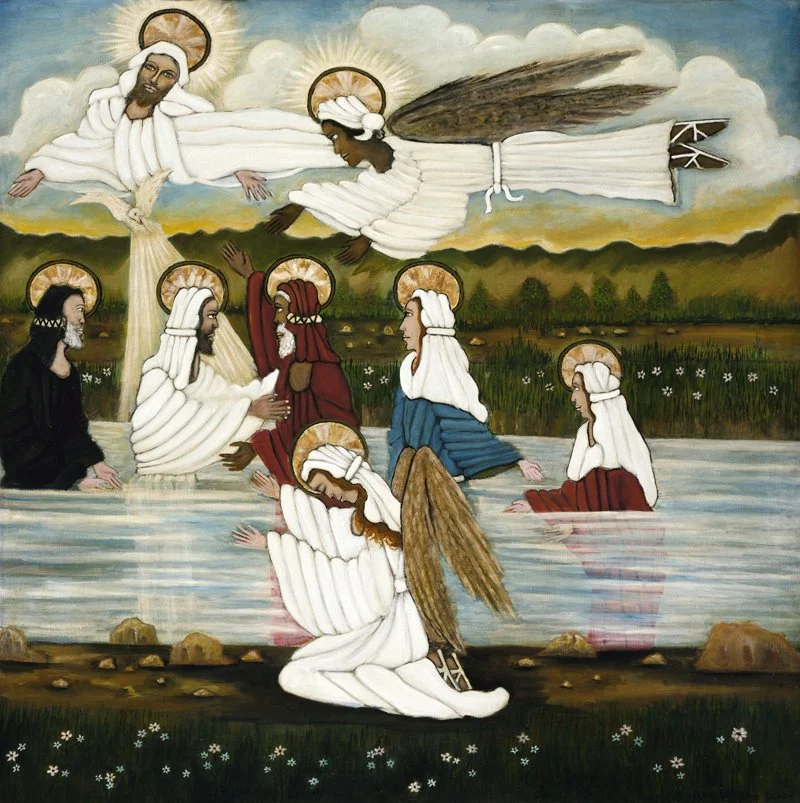
2. Lorenzo Scott -The Baptism of Jesus [Courtesy of the Smithsonian Museums. © Smithsonian.)
3. Clarence Gagnon - Midnight Mass
4. Simon Silva - Amor A Todas Horas [Used by permission of the artist.]
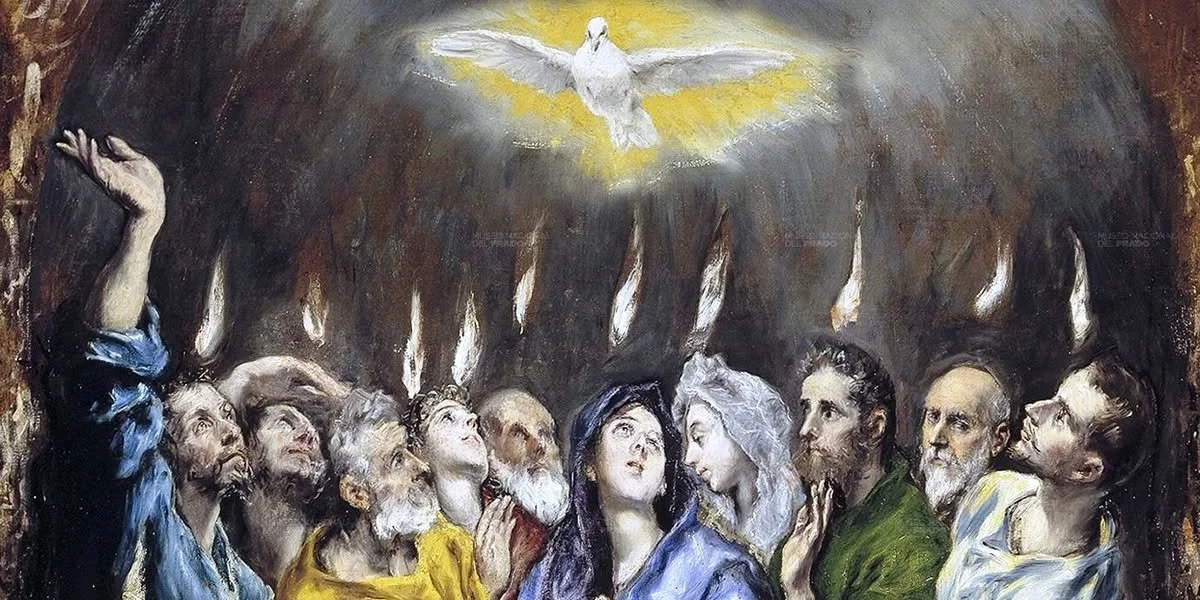
5. El Greco – Pentecost
6. Giotto di Bondone - Stigmatization of St. Francis
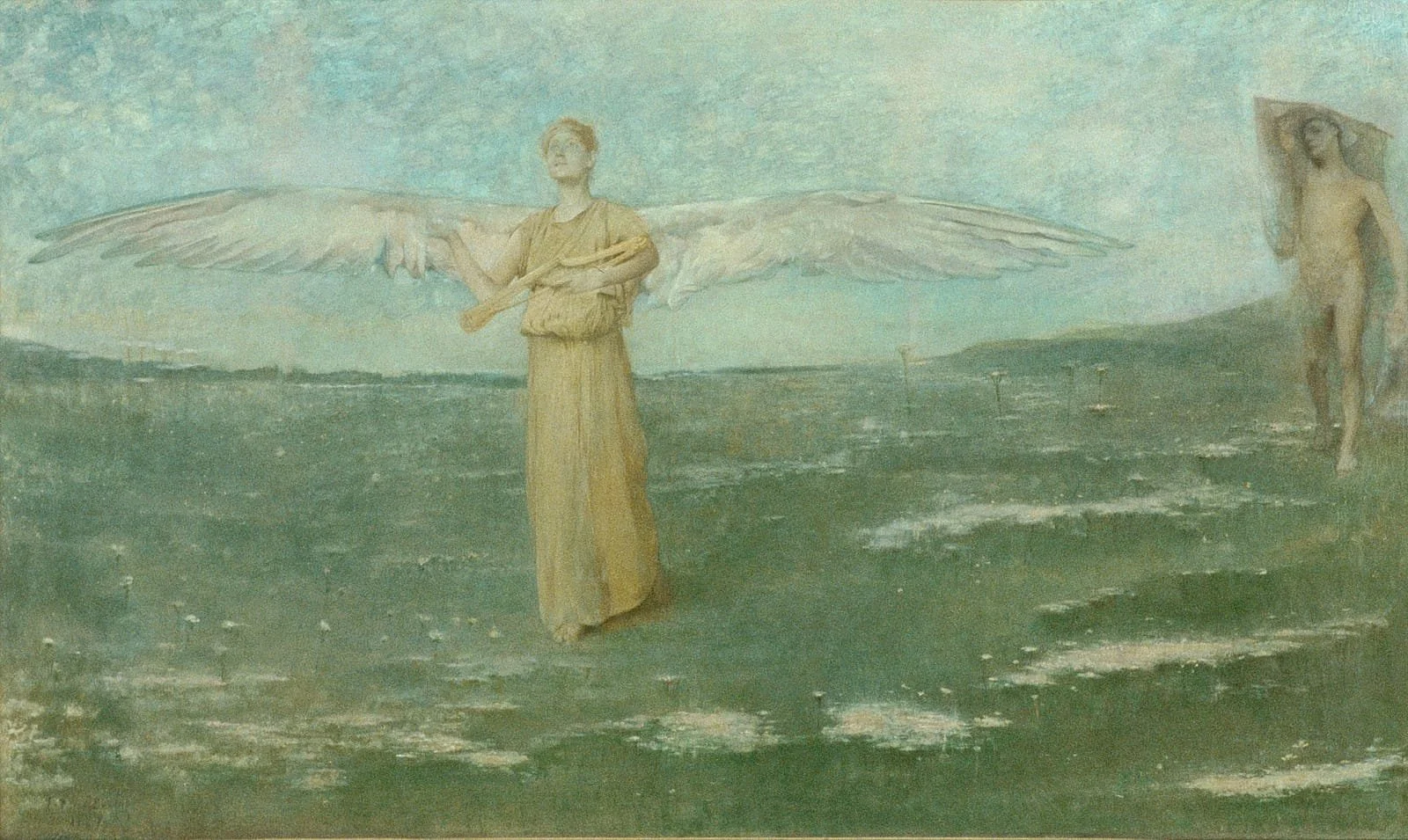
7. Thomas Wilmer Dewing -Tobias and the Angel
8. Ivan Kramskoy – Herodias
For more information about the artists, visit their website:
1. Michelangelo Merisi da Caravaggio - The Scourging at the Pillar
2. Lorenzo Scott -The Baptism of Jesus (Courtesy of the Smithsonian Museums. © Smithsonian.)
3. Clarence Gagnon - Midnight Mass
4. Simon Silva - Amor A Todas Horas (Used by permission of the artist.)
5. El Greco – Pentecost
6. Giotto di Bondone - Stigmatization of St. Francis
7. Thomas Wilmer Dewing -Tobias and the Angel
8. Ivan Kramskoy – Herodias
Deadlines and Dates:
The contest opens for submissions 11/15/25.
The contest ends 3/31/26 at 11:59 p.m. CST.
Winners will be announced on the Catholic Literary Arts website by April 27, 2026, 11:59 p.m. CST.
The judge’s comments will be posted along with the text of the winning poems, visual image, and link to author’s websites, if applicable.
All non-winners will be notified by April 27, 2026, via Submittable.
Virtual Reading by Winners and Finalists
We invite all poets and their friends and family to attend a joyous virtual celebration via Zoom on Monday, May 4, 2026, 7:00 p.m. CST. This event will give us an opportunity to enjoy sacred poetry read by the poets themselves.
Our final judge Daniel Tobin will attend this virtual celebration and read previously prepared comments on each of the three winning poems.
Click here to register for Virtual Celebration by Winners and Finalists.